Find the path for the work you do.
AI Developer Toolkit is written for four readers: the developer, the tech lead, the CTO and the executive. Each has an ordered reading path, a free scorecard that places you on the ladder, and a book built from the same pages. Seven kinds of work have a page of their own.
$59.99 once for 12 months of access. Nothing renews on its own. 30-day refund on a first purchase.
Each role gets the situation we wrote it for, the first four steps of its reading path, a book and a scorecard. Steps marked Free are open to everyone.
Developer
Your job: climb the ladder from a first real task to reviewing evidence instead of every diff.
You already use an agent. Some days it saves an afternoon; other days you spend the afternoon reading what it wrote, because nothing tells you whether to trust it.
What changesThe habits that fix that arrive in the order they pay off, and each step ends in an artifact that proves it is done.
-
Place your current workflow on the ladder, so every later step is a move up one rung.
Done whenYou can name your level and the one habit that keeps you on it.
-
Your tool’s quick start: Cursor · Claude Code · Codex
ToolkitGet one tool installed, configured and through a first real task in your repository.
Done whenA merged change the agent wrote, with the tests it ran.
-
AGENTS.md and CLAUDE.md — concise repository context
ToolkitThe instructions file is the cheapest lever on output quality; write it before you scale use.
Done whenA reviewed CLAUDE.md or AGENTS.md under 150 lines with the real test commands.
-
Permissions, sandboxes and approval modes across Claude Code, Codex and Cursor
ToolkitDecide what the agent may run without asking before you let it run longer.
Done whenA committed permission policy and a sandbox for anything with network or secrets.
12 more steps follow, from the artifact chain and executable acceptance criteria to an issue-to-pull-request pipeline.
Read all 16 steps with the Toolkit Read all 16 steps
$59.99 once for 12 months of access. Nothing renews on its own. 30-day refund on a first purchase.
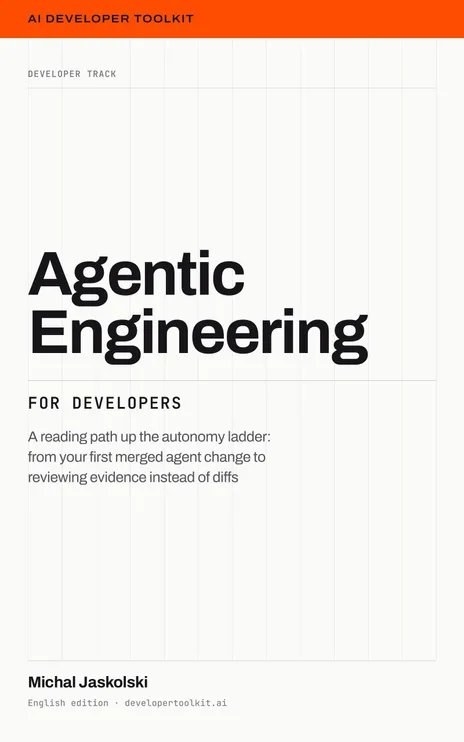
Role path book
Agentic Engineering for Developers
16 steps, 2 further reading. EPUB and PDF, English and Polish. Included in the Toolkit.
Also on amazon.com: Kindle on amazon.com, opens in a new tab
AI Dev Score
25 questions, about 8 minutes. Free.
Take the AI Dev ScoreNo account, no card. An email only at the end, and only if you want the full playbook.
- Your rung on the autonomy ladder, as soon as you finish
- The part of your workflow that holds you there, scored section by section
- A 30/60/90-day plan for the one move to the next rung
- Plan: Intent & Foundations
- Design: Specs & Policy Skills
- Build: Plans, Rules & Parallelism
- Test: Feedback Loops & Continuous Evals
- Deploy: Review Loops & Production Gates
- Maintain: Closed Loop & Incident Response
Tech lead
Your job: standardize the harness, own verification design and run review capacity, so the whole team moves up a rung and not one power user.
One engineer merges five agent pull requests a day, two refuse the tools, and review is the slowest part of delivery.
What changesYour job moves from writing code to designing the system that decides whether code ships.
-
One frame for maturity, process and capability before you change how eight people work.
Done whenYour team placed on the map, loop by loop.
-
Most teams stall at Level 3; know its review ceiling before you plan past it.
Done whenThe team knows how many diffs a week it can really review.
-
The standard the team moves to: evidence first, code only for escalation classes.
Done whenEscalation classes agreed with the team.
-
DORA, SPACE, DX Core 4 and AI measurement when agents write the code
ToolkitSet the baseline before the rollout, or you will not be able to show what moved.
Done whenFour weeks of baseline data for the metrics you will report.
12 more steps follow: bringing skeptics along, the shared rules core, an agent-ready backlog, evidence bundles, the review queue and moving the team from reading every diff to trusting the evidence.
Read all 16 steps with the Toolkit Read all 16 steps
$59.99 once for 12 months of access. Nothing renews on its own. 30-day refund on a first purchase.
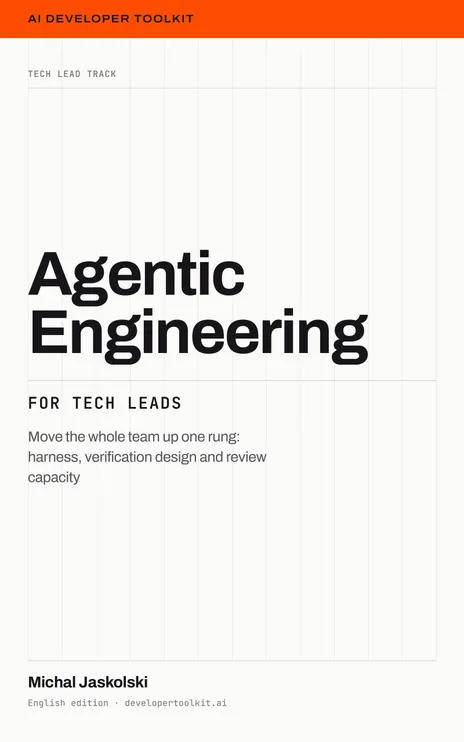
Role path book
Agentic Engineering for Tech Leads
16 steps, 4 further reading. EPUB and PDF, English and Polish. Included in the Toolkit.
Also on amazon.com: Kindle on amazon.com, opens in a new tab
Tech Lead Scorecard
25 questions, about 8 minutes. Free.
Take the Tech Lead ScorecardNo account, no card. An email only at the end, and only if you want the full playbook.
- Your team’s rung on the autonomy ladder, as soon as you finish
- Where the team is uneven: standards, review gates, rollout, workflow, enablement, ops
- A 30/60/90-day plan that moves the whole team
- Shared standards & context
- Review & quality gates
- Rollout & adoption
- Team-scale workflow
- Enablement & mentoring
- Team ops & governance
CTO
Your job: decide ten things in order, from evidence and a measured pilot to autonomy, security, spend, regulation and the board.
Every team already runs agents, invoices are rising, and security asks who approved an agent that opens pull requests. The board wants a number; you have seat counts.
What changesEach decision ends in a named artifact with an owner, so “done” means the artifact exists. You pilot one team before you staff a platform.
-
The dated third-party evidence, publisher by publisher, before any decision.
Done whenYou can cite three sources with dates for the shift you are planning.
-
One map of maturity, process and capability that every team in the org can place itself on.
Done whenThe organization described as a distribution of merged change across levels.
-
The operating principle: humans judge evidence and risk, not every line.
Done whenThe principle adopted as policy for at least one risk class.
-
DORA, SPACE, DX Core 4 and AI measurement when agents write the code
ToolkitPick the measurement frame before the pilot, so the pilot can prove something.
Done whenMetric definitions signed off by engineering and finance.
12 more steps follow: a pilot with a control group, the operating model, cost per accepted change, autonomy by risk class, agent security, spend, vendor risk, the EU AI Act and the board update.
Read all 16 steps with the Toolkit Read all 16 steps
$59.99 once for 12 months of access. Nothing renews on its own. 30-day refund on a first purchase.
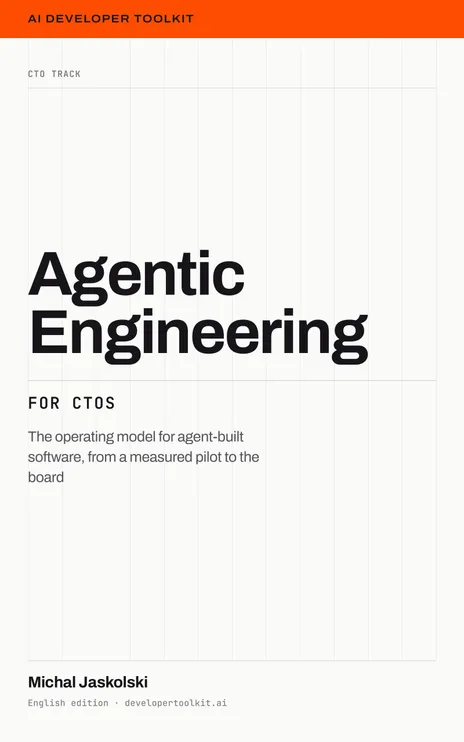
Role path book
Agentic Engineering for CTOs
16 steps, 4 further reading. EPUB and PDF, English and Polish. Included in the Toolkit.
Also on amazon.com: Kindle on amazon.com, opens in a new tab
C-Level / Founder Scorecard
25 questions, about 8 minutes. Free.
Take the C-Level / Founder ScorecardNo account, no card. An email only at the end, and only if you want the full playbook.
- Your organization’s rung on the autonomy ladder, as soon as you finish
- Where the controls are thin, from adoption and spend to quality gates and ROI
- A 30/60/90-day plan and the three risks to name before someone else does
- Adoption & spend
- Shared infrastructure
- Quality gates
- Parallelism at team scale
- Org enablement
- Strategy & ROI
Executive
Your job: fund and approve agent adoption on dated evidence, without reading code or taking anyone’s word.
Your CTO wants a coding agent for every engineer, a vendor deck promises a multiple, a board member forwards a study saying developers got slower, and finance asks about headcount.
What changesA ten-minute brief with a publisher and a date on every number, then one step per decision leadership owns: economics, business case, org design, roadmap and board reporting.
-
What changed, according to whom, and when: the dated evidence first.
Done whenYou can separate sourced claims from vendor marketing.
-
One picture of how far along your engineering organization is.
Done whenYou can ask your CTO where each team sits on the map.
-
Why quality can be proven without people reading every line of code.
Done whenYou know what evidence to ask for before approving more autonomy.
-
The economics of agent-built software: cost per accepted change
ToolkitThe economics of agent-built software: cost per accepted change.
Done whenA cost baseline your finance team agrees with.
4 more steps follow: the business case, how teams and headcount change shape, the organization-wide roadmap and reporting to the board.
Read all 8 steps with the Toolkit Read all 8 steps
$59.99 once for 12 months of access. Nothing renews on its own. 30-day refund on a first purchase.
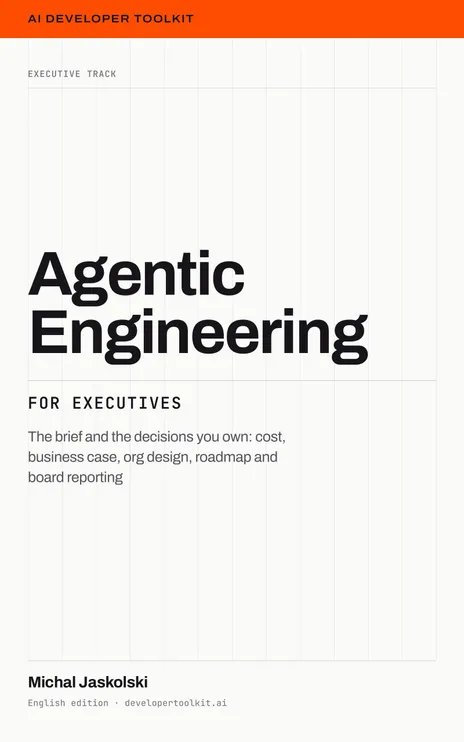
Role path book
Agentic Engineering for Executives
8 steps, 6 further reading. EPUB and PDF, English and Polish. Included in the Toolkit.
Also on amazon.com: Kindle on amazon.com, opens in a new tab
C-Level / Founder Scorecard
25 questions, about 8 minutes. Free.
Take the C-Level / Founder ScorecardNo account, no card. An email only at the end, and only if you want the full playbook.
- Your organization’s rung on the autonomy ladder, as soon as you finish
- Where the controls are thin, from adoption and spend to quality gates and ROI
- A 30/60/90-day plan and the three risks to name before someone else does
- Adoption & spend
- Shared infrastructure
- Quality gates
- Parallelism at team scale
- Org enablement
- Strategy & ROI
Engineers at these companies work with AI Developer Toolkit
- Grupa Morizon-Gratka
- Ringier Axel Springer
- TasteRay
Creator of wondel.ai Skills — 2.3k+ stars on GitHub (opens in a new tab)
Seven kinds of work, each with its own page.
Adopting an agent looks different from a backend service, a component library, a CI pipeline and a board meeting. Each page names what changes for that work, points to the recipes for your stack, and ends at the scorecard that fits.
One report, three desks: the same output gain lands differently on each.
Faros AI, “AI Engineering Report 2026”, April 2026 (opens in a new tab). 22,000 developers, more than 4,000 teams, vendor telemetry.
Output went up, and so did review time and incidents. Each role’s path works on the part that role owns: your own review habits, the team’s review queue, the organization’s controls.
Questions about your role.
Something else? Write to support@developertoolkit.ai.
Which role am I if I do more than one job?
Start with the path for the work you do most days. Every path opens on free ladder pages, so what you read first carries over if your role changes.
What does a scorecard cost, and what does it ask?
It costs nothing. You give your answers to 25 questions in about 8 minutes, with no account and no card. An email comes only at the end, and only if you want the full playbook.
What is free, and what needs the Toolkit?
The Autonomy Ladder and Start here sections, including each role’s path page and the quick wins, are free for everyone, and so are the scorecards and the MCP server. Every other guide counts toward 5 free articles a month (10 with a free account). The Toolkit opens all of them, the recipes and the books for 12 months.
Is there a book for my role?
Yes: Agentic Engineering for Developers, Agentic Engineering for Tech Leads, Agentic Engineering for CTOs and Agentic Engineering for Executives. They reuse the library’s pages in the order your role needs, in EPUB and PDF, English and Polish, and they come with the Toolkit.
I only use one of the three tools.
That works. The developer path branches by tool at the quick start, and every other step is shared; each page shows all three tools where they differ, so moving to another tool later costs you little.
My kind of work is not on the list.
Start with the path for your role, and take the scorecard that fits it. The pages above cover the kinds of work we have written recipes and scorecard advice for so far.
Your level has a name. Find it in about 8 minutes.
Take the free scorecard for your role. Or buy the Toolkit and read the path in order.
$59.99 once for 12 months of access. Nothing renews on its own. 30-day refund on a first purchase.